
Squeezing the music from the Squeezebox
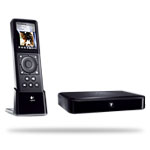
A glimpse into the future of Audio.
If you were ever wondering what is the future of hifi - this is it.
Thats how we will listen to the music in the first half of 21st century.
The modifications prescribed below
have been very strongly modified on May 25th 2010.
Enter the Squeezebox.
This system is not from Levinson, not from Jadis, not from Cello, not
from Sonic Fronteers. This is from the people who make PC mouse. This
is
LOGITECH !!!
Apparently Logitech is the company which identified best the real needs
of
audiophiles Anno Domini 2008. They did the HOMEWORK. This is
called the Voice of Customer . Squeezebox is a device which bridges the
computer world and audio world. It can be considered a virtual
transport. It has a super cool remote which is one of the most sexy
toys for boys I ever saw. It operates in wifi domain, not infrared, so
it can be taken around the house. It has a display which is able to
show the cover of the album !!! And it blends seamlessly the
internet music radio stations, network music
servers and our own computer with music. It also blends seamlessly the
MP3 world and wav slash aiff slash flack or ape worlds.
The squeezebox frees us from the TRANSPORT problem, and allows the full
digitalization of all music we have on CDs onto hard drive, without any
compromise in quality. No need to compress to MP-3 our collection - we
can use
lossless files and preserve all the beauty of 16-bit 44 kHz audio.
AND we can have a shadow copy of all that we own - on MP3 for portable
use.
No more laser problems, no more skipping discs. No more dropping the
jewel box on the floor which means broken hinges.
 Stolen
from Logitech site
Stolen
from Logitech site
A side note: I consider the CD jewel box a serious contender to the
award of WORST ENGINEERING EVER.
Other contenders are:
RCA plug/socket combo which makes MAKE of the signal before the grounds
are equalized. WHO IN THE WORLD invented this crap ??? If it is called
RCA, why does a huge reputable company endorse something, which
deserves 100 whips at the whipping post ? The RCA name stuck to this
stupid plug forever. While all it takes to make it perfect is to
shorten the center pin by 4 mm.
Another contender is PERPENDICULAR PARKING. 90 % of parking lots in
Poland , even these designed from scratch without space constraints -
use 90 degrees parking bays. Moreover, there are street curbside
parking bays which are surrounded by half foot curb AND PERPENDICULAR
at the same time. Entering or exiting such parking spot requires a
maneuver across three lanes of traffic. All it takes to make a perfect
parking bay is to skew it by 45 degrees which costs absolutely the same
.
Three other genius designs on my list are: toilet flushing button
located centrally on the flushing
reservoir, around the middle of human spine area, requiring a
super-unnatural twist of spine when we are the
least in the mood for yoga. As if that location was deliberately
selected to be totally unreachable unless we stand up and turn around
mid you know what.
Another one is a set of schampoo/conditioner, in two identical bottles,
with huge company logo on them (font 36) , much smaller descriptor of
whatever
biological ingrediends were used (almond, jojoba, honey, aloe,
lemongrass, green tea, parsley, garlic and pine resin) - in font
12, but the words: shampoo
and conditioner are
written with font number 6 when we stand in the shower without glasses
and with foam in the eyes, trying in vain to tell which is which.
According to Woody Allen, the winner of all that contest is of course
... aluminium siding.
Back to squeezebox - it means we never have to look for the ONE CD
which we want to listen to and someone just placed it under different
letter
of alphabet on the shelve, or even worse - our kids just lent it to
their buddies to copy at home.
If somenone needs a copy - the squeezebox owners can just press the
BURN button and have
a freshly burned ROM within minutes, or even going next step forward -
we can share with friends the entire collection by a simple diskcopy function. Maybe not
really legal - but technically doable.
There are many squeezeboxes there: the most simple is the monophonic
kitchen radio called just that - Squeezebox Radio. Internally it is
stereophonic and it has stereo phones output plus own amplifier and
very nice monophonic two way loudspeaker. It has all the functionality
of the squeezebox remote, with nice color display etc. It is
lacking the SPDIF output so we cant use it as a transport. At least one
hour of sniffing around the PCB with a scope did not allow me to find
the SPDIF. It is harder to find than a G-spot. But maybe - who
knows - it is somewhere there.
A notch above is a stereo radio called Boombox. This one I do not know.
The Duet which I portrait here is a neat solution - the CD transport
and remote. There is also a very similar classic - which has own
display on the box and a blind cheap remote.
Considering the absolutely overwhelming amount of information about the
songs and artists and albums - the one line display of the Classic is
for mi inadequate. I would be lost.
Believe me - in the end - the COMPUTER SCREEN is the only practical way
of accessing the database. I have over 50 000 songs on my drive,
and for example - some of the Pat Metheny albums are listed as Pat
Metheny, some as P. Metheny, some as Pat Metheny Group, some as Pat
Metheny Trio, and some - under T letter - as The Pat Metheny Group. Try
to find the right song with one line alphanumeric display.
IMPOSSIBLE.
And of course - the coolest one is Squeezebox Transporter - the
ultimate toy for 2500 Bucks.
But we can modify the Duet to be as good or better than the Transporter
with just a handful of caps.
Squeezecenter
Squeezecenter is a web application which runs on the computer and
manages the song database. It will scan the HDD and automatically
retrieve all the data, songs, albums, artists, metatags, cover art etc.
It can read iTunes database and share it.
Squeezebox Duet
The squeezebox Duet - is a small box which is a LAN / WIFI
router which pulls
the data from whatever storage (PC, MAC or RAID) - and converts
it to
Audio (analog RCA or digital SP/DIF)
Theoretical modell is then a silent computer (like iMAC for example, or
ATOM based silent PC, or the fileserver like Q-nap or Vortex box,)
plus large HDD drive (1TB or larger) and the system
becomes a TRANSPORT and music file server. Connect it to the high-end
DAC and then to amps and you have a system replacing the traditional CD
player. by using a Lampizator with the squeezebox own internal DAC we
can get away without the external DAC. The Wolfson should do just fine.
Squeezebox has an onboard simple cheap Wolfson DAC which I tried and I
confirm that it is good. Not top of the line but good enough. I added
6H6P tubes tapping to the analog outputs of this DAC and I was very
satisfied.
It is gonna take some time before we will put all our CDs on hard drive
- months perhaps. Bu we do it once in a lifetime. I found it to be the
best pocketmoney job for the kids.
I listened once to the basic Squeezebox at audiophile friend's Richard
W and it
was connected to Audionote DAC3,1 and sounded absolutely fantastic so I
konw it is possible. I have no knowledge if his squeezebox was tweaked
or stock. I assume it was stock. There was absolutely not a trace of
sonic compromise compared to CD transport. The dog on Roger Waters'
Amused to Death still barked behind my head.
THE big question is - will my S-B play halfway decent music? Can we
sacrifice our precious CD players ?
Can we live with Squeezebox AND be able to look into the mirror in
the morning ????
The Squeezebox is small cheap and simple, but it uses premium parts.
Chips
are first rate, PCB is neatly soldered, everything looks OK except the
wall-wart power supply which is a low budget one. I suggest to use a 20
VA transformer with 12 VAC secondary, put a bridge, and add a
regulator like LM3XX or 7809 with two good electrolytes and start
from there:
The remote belongs to a different world. It looks better than any CD
remote I ever saw, definitely not in LOGITECH class. As if the main box
- The Duet and the remote were separated by worlds in the quality
class. I guess the remote represents 80 % of the product cost. And
rightly so because that is the human interface which we touch, and the
box - well - disappears under our DAC and amps.
Modification recipe for squeezebox a'la Fikus
Lets closely analyze belof picture:
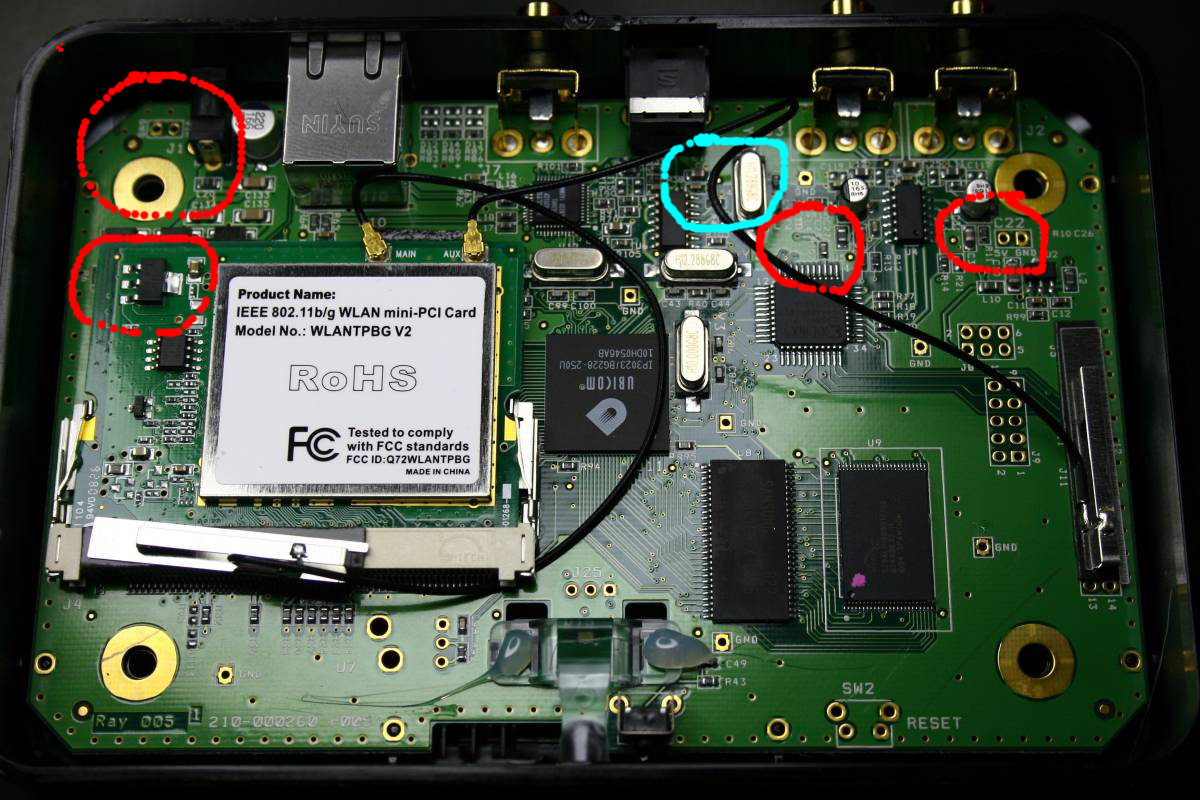
On the picture you see the whole inside of squeezebox, with two
antennas for wifi. Very nice.
1. Upper left red ring:
this is input of power. My suggestion is to install a good cap (oscon
220/10V or Tantalum or blackgate - any size between 100 uF and 3300 uF
by 10 V or more)
You install it in the two small golden holes which are above the J1
mark. This takes care about the raw 9V DC supply.
2. Lower left red ring:
there is a three legged regulator chip. It is very important.
I suggest to add two small caps like 47 uF or more by 6,3 V or more.
Left upper leg is GND. Solder both cap's minus legs to the GND (which
is everywhere under the green lacquer like a ground plane)
Solder one cap plus to middle leg, second cap plus to the lowest leg,
like in this circle. I used Tantalums 100/10V
3. Upper red right side circle: this is another important regulator.
Install a good cap in the two golden holes under the mark C22
(marked 5V and GND) . Try 47 uF or more by 6,3 V or more. I used Os-con
220/10.
Add another such cap - minus leg to the other cap's GND, and plus leg
to the lower point of the smd L2 inductor (third leg of the regulator
U2.
4. Middle red circle shows the real source of S/PDIF signal.
Just gently desolder R102 attached to pin 3 of the XILINX. Solder a
capacitor - one leg to the lower soldering pad left after removal of
R102. It will be directly connected to Pin 3 of the Xilinx.
The other leg of that cap (any foil type like MKP, MKT, MKS, or even a
ceramic, size between 10 nF and 220 nF, ) connects to a 200 Ohm
resistor. The other end of this resistor connects to the center pin of
the RCA with SPDIF. First - cut off the RCA center pin from the pcb and
float it.
Last point: solder across the RCA - between center and GND surrounding
golden frame - a resistor 75 Ohms. (or 58 Ohms if you want to be close
to real RCA and coax impedance).
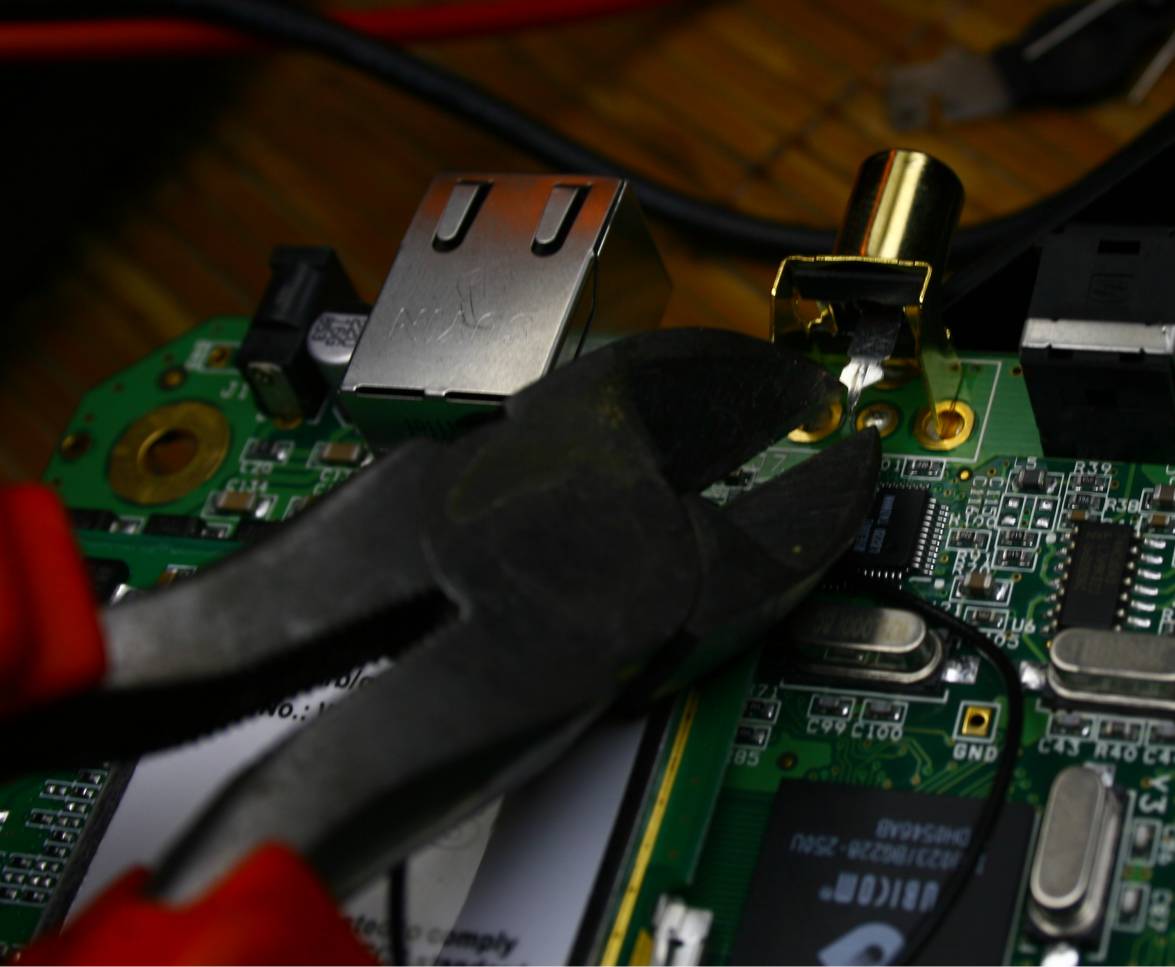
That's all as far as good spdif is concerned.
It should play BETTER than any CD transport you ever heard or you did
something wrong.
In my system it beats the 5000 dollar CEC TL1X so badly that it isn't
even funny. It literally trashes it !
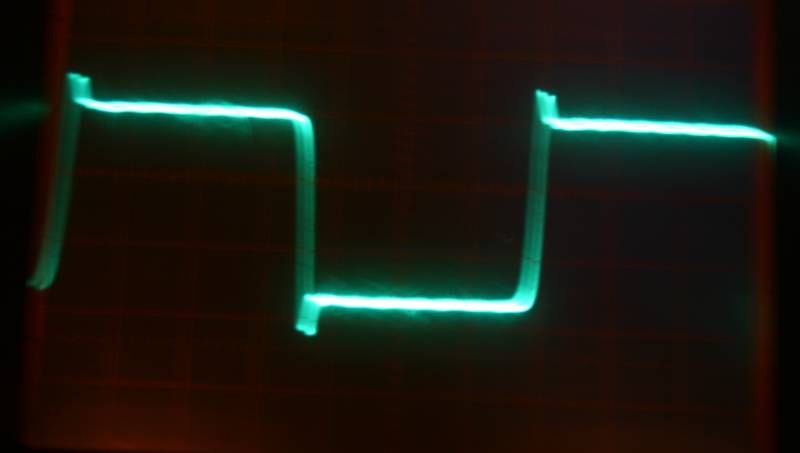
This above is the stock form SP/DIF trace. Nice but with slight
overshoot.
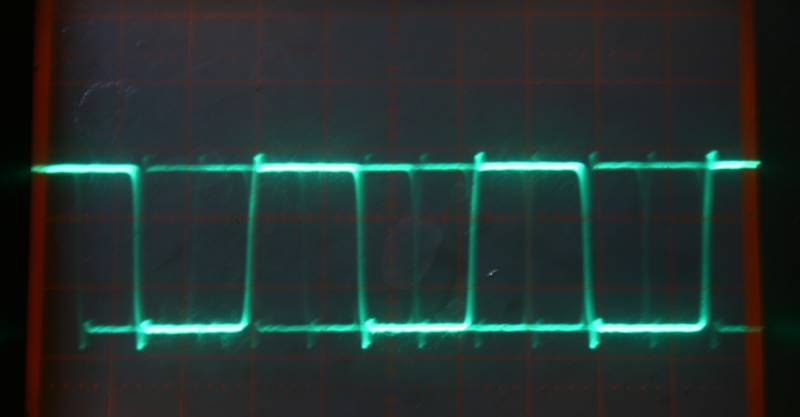
This is the trace after all mods. Still good but overshoot is much
smaller. It will disappear after the digital cable is connected - its
capacitance will remove the overshoot
Good Chips inside Squeezebox
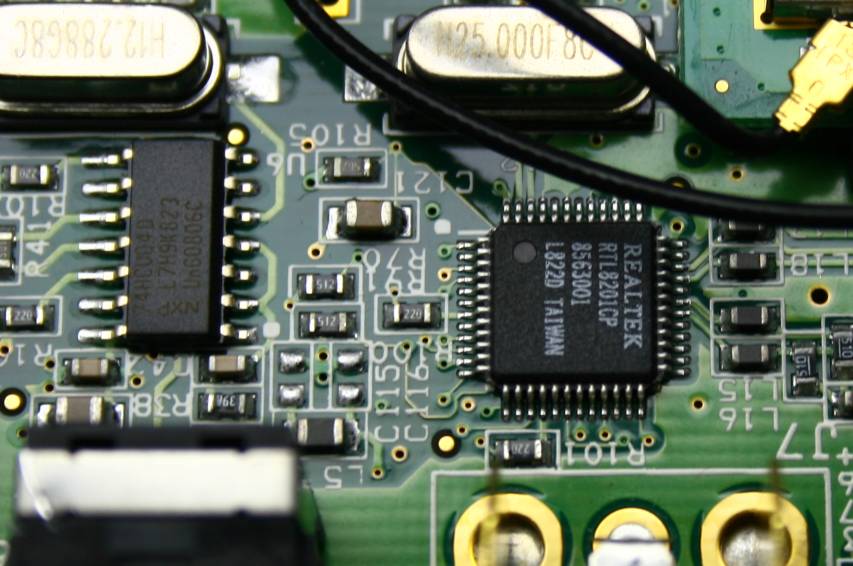
Realtek RTL8201cp
This chip is responsible for translating the LAN data into our audio
digital data. It is first class chip from Taiwanese specialist.
(from their website)
The RTL8201CP is a
single-chip/single-port PHYceiver with an MII (Media
Independent Interface)/SNI
(Serial Network Interface). It
implements all 10/100M Ethernet
Physical-layer functions including the
Physical Coding Sublayer (PCS),
Physical Medium Attachment (PMA),
Twisted Pair Physical Medium
Dependent Sublayer (TP-PMD), with an
auto crossover detection function,
10Base-Tx Encoder/Decoder,
and Twisted Pair Media Access Unit
(TPMAU).
A PECL (Pseudo Emitter Coupled Logic)
interface is supported to connect
with an external 100Base-FX
fiber optical transceiver. The chip
utilizes an advanced CMOS process
to meet low voltage and low
power requirements. With on-chip DSP
(Digital Signal Processing)
technology, the chip provides
excellent performance under all
operating conditions.
There is not much to upgrade in LAN chip but a good supply cap will
never hurt:
Below you see the pins of power to the Realtek.

take two good caps like Tantalum or Oscon (minimum 10 uFtill
100uF by 6,3 VDC and connect like this:
between pins 35 (GND) and 36 (positive supply 3,3 VDC)
The same between pins 11 or 17 or 45 (GND) and 14 or
48 (positive supply 3,3 VDC)
Of course do not attempt to solder the chip pins directly - they are
too small - solder the next available parts on the trace.
Digital Ground should be connected to a larger GND plane.
I did not perform this job due to too small pins and lack of skills in
such microsurgery.
S/PDIF generator
In the Duet the S/PDIF is put out by the 74HCU04D.
But - after getting some help from a pen-pal I can confirm that
the real origin of SP/DIF is Xilinx chip - namely the pin number 3
which leads to resistor R102. Gently lift the R102 and solder your wire
to the point of R2 connected to chip pin3. This way we tap to Pin
3 without soldering such thin fragile chip leg directly. R102 is
removed - so rest of the circuit is not affecting our PURE CLEAN SPDIF!.
The old way by 74HCU chip is inferior.
This is a standard Philips chip (from NXP - remember - the same lab
which brought us the TDA1541 !) performing data output formation
for
SP/DIF. If we add better power capacitor we can marginally improve the
output response perhaps.
SP/DIF signal is present on leg 2 (and 4)
Power 3,3 V DC or 5 V DC is on pin 14th.
Below - for reference - is the 74HC chip with the old way of signal
tapping, before I was introduced to the XILINX pin 3 scenario.
The SP/DIF on the buffering 74HC chip can be stolen at the source - leg
2nd and wired to
output RCA directly (first- float the RCA-HOT pin please)
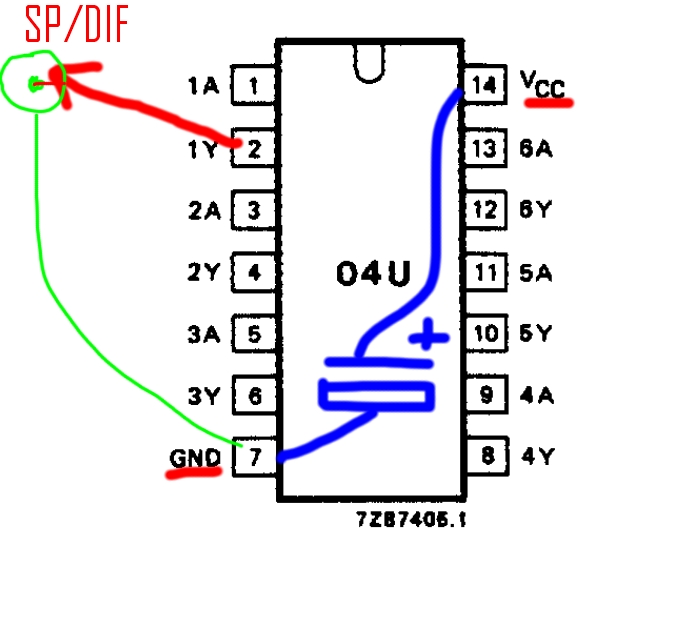
To steal clean SP-DIF signal, lift or remove R38 and solder to the cap
end C42 on the side closer to pin2 of the chip.
(buzz it first)
When soldering - always put a fresh drop of solder on the PCB where you
perform soldering because as it is ROHS compliant PCB it has lead free
solder and does not hold to additional parts. The old-school, leaded
solder
must blend with the RoHS solder to hold well.
Wolfson Microelectronics WM8501
Well well well, look who is here. A wolfson - the younger and poorer
brother of one of the best DACS in the mankind history - the WM8740
which I was drooling about so many times before. Maybe a company as
reputable as Scottish Wolfson did preserve most of the beauty of their
highend chip in this one ? It is still 24/192 chip with all the
features except balanced outputs.
The chip has built-in output stage with some digital and analog
filtering, so the direct signal is already almost perfect without need
of
filtration or amplification.
I tried many scenarios of lampization of this DAC and finally - to
avoid many problems - I came up with this proposal:
LAMPIZED SQUEEZEBOX
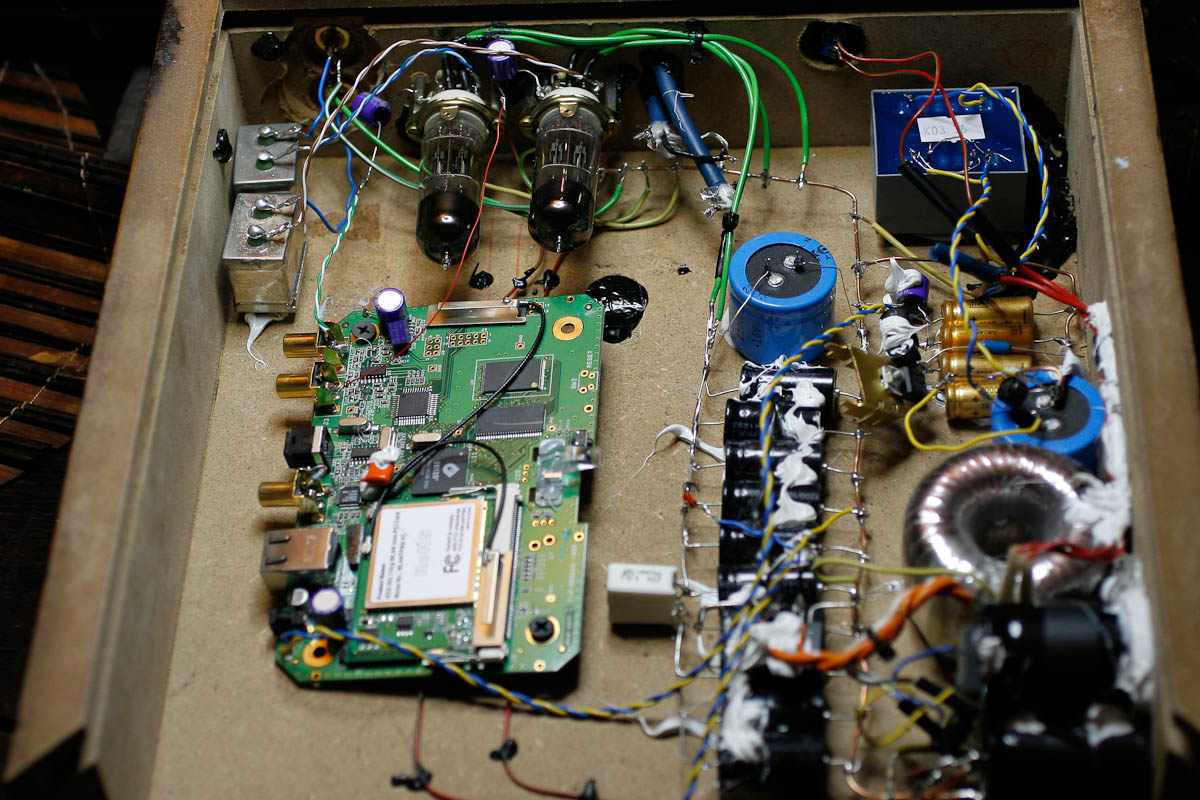
Above: I used all leftover caps from my drawer - and in one vicious
orgy of gluing I mounted a monstrous power supply in the wooden box.
Why wood ? to enable the wifi to go through.
I have regulated 9V DC for the squeezebox, 200 V for the tube anodes,
6,3 V for tube heaters, Later I added 10 V for the superclock.

6H6P of course.
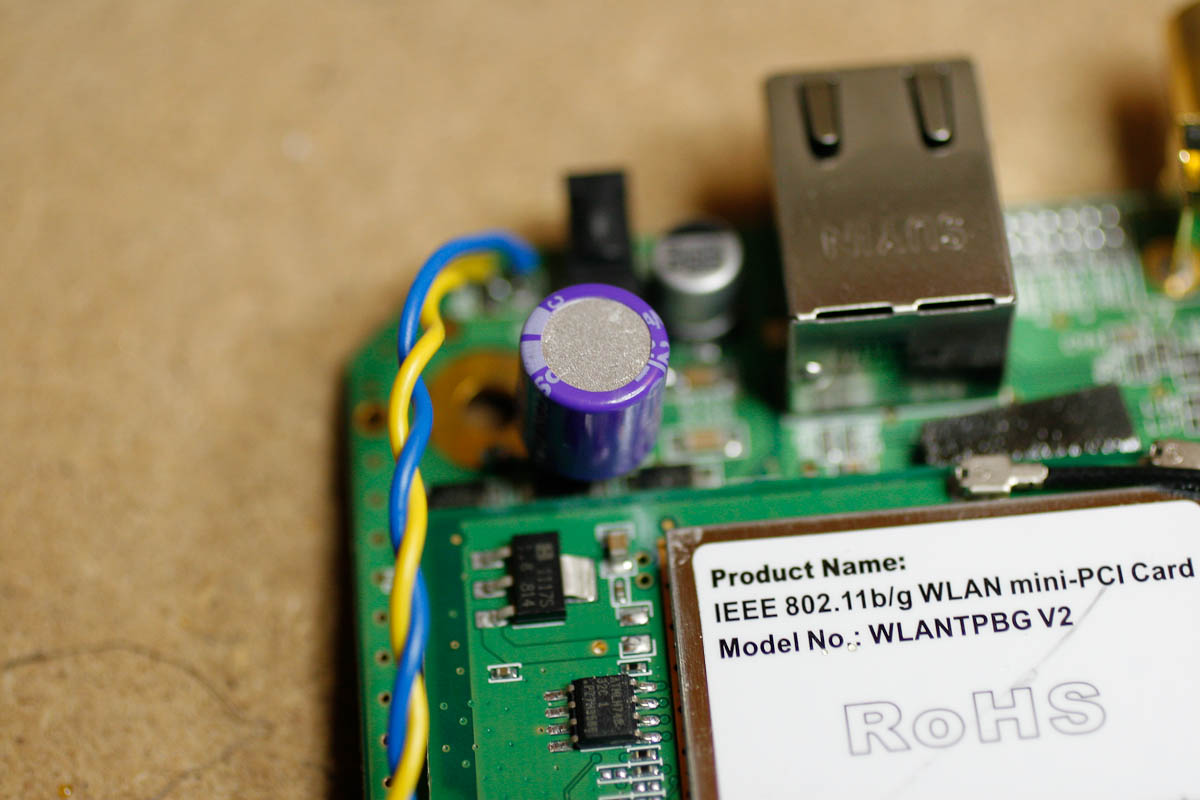
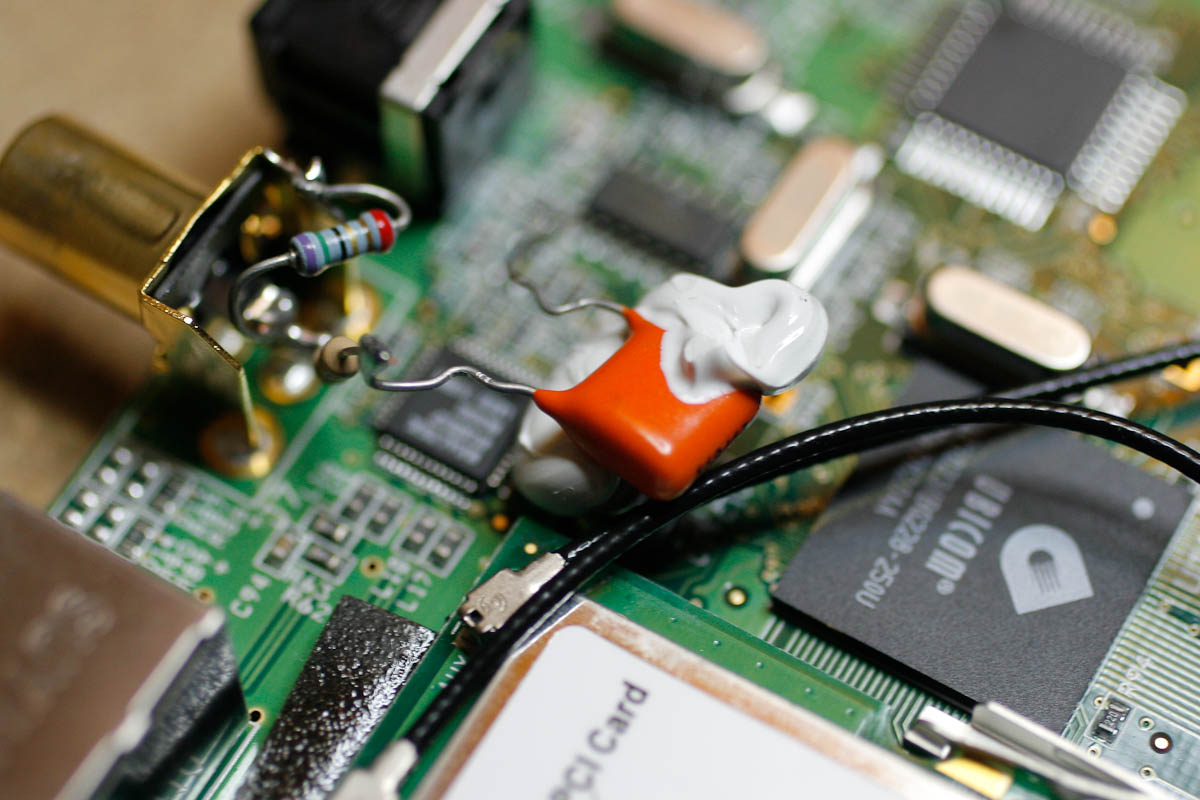
Above: the S/PDIF output with Vishay MKP cap 220n/63V.
Back to Wolfson DAC chip ...
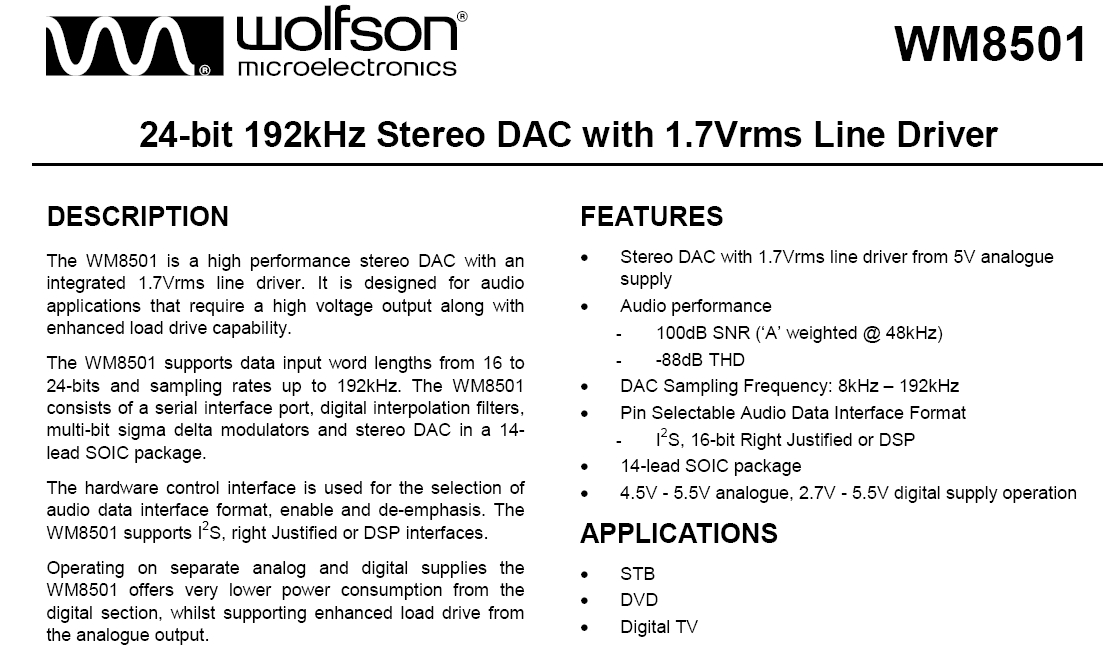
http://www.wolfsonmicro.com/uploads/documents/en/WM8501.pdf
Channels:
R=pin 6, L=pin 9,
power +5VDC Analog supply leg 8
3,3VDC digital supply leg 11
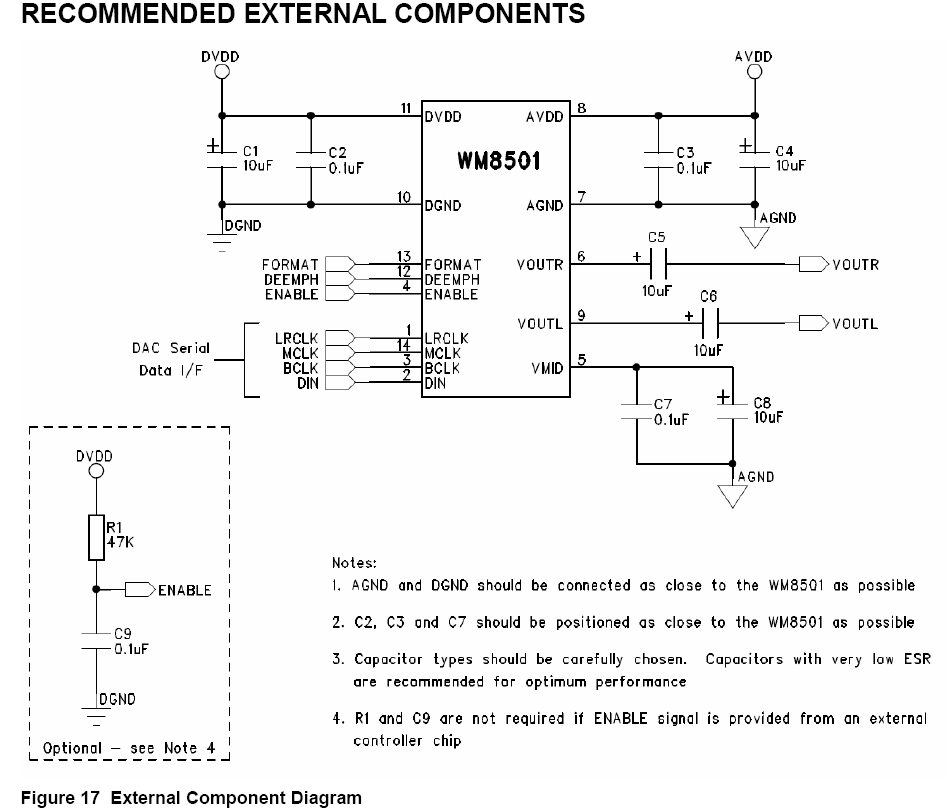
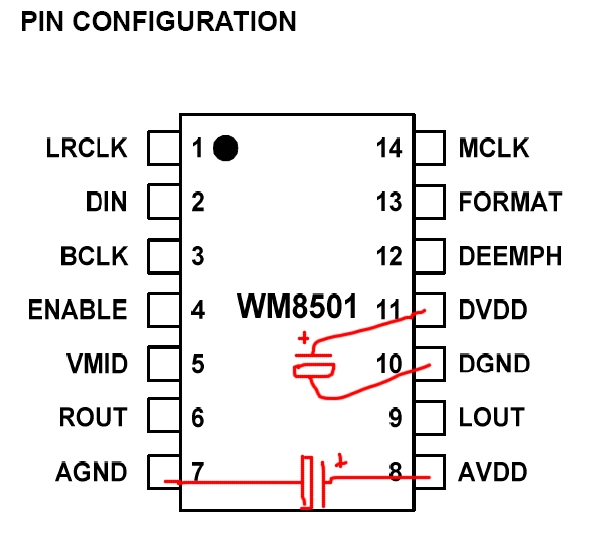
To improve caps in this DAC I did not do as on picture above but I
found tha main cap which supplies both analog and digital input - the
capacitors C10 (3,3V) and C30 (5V) . I put across it a bypass oscon
33uf/16 V which is a
perfect size phisically.
Upgrading Analog output of Squeezebox
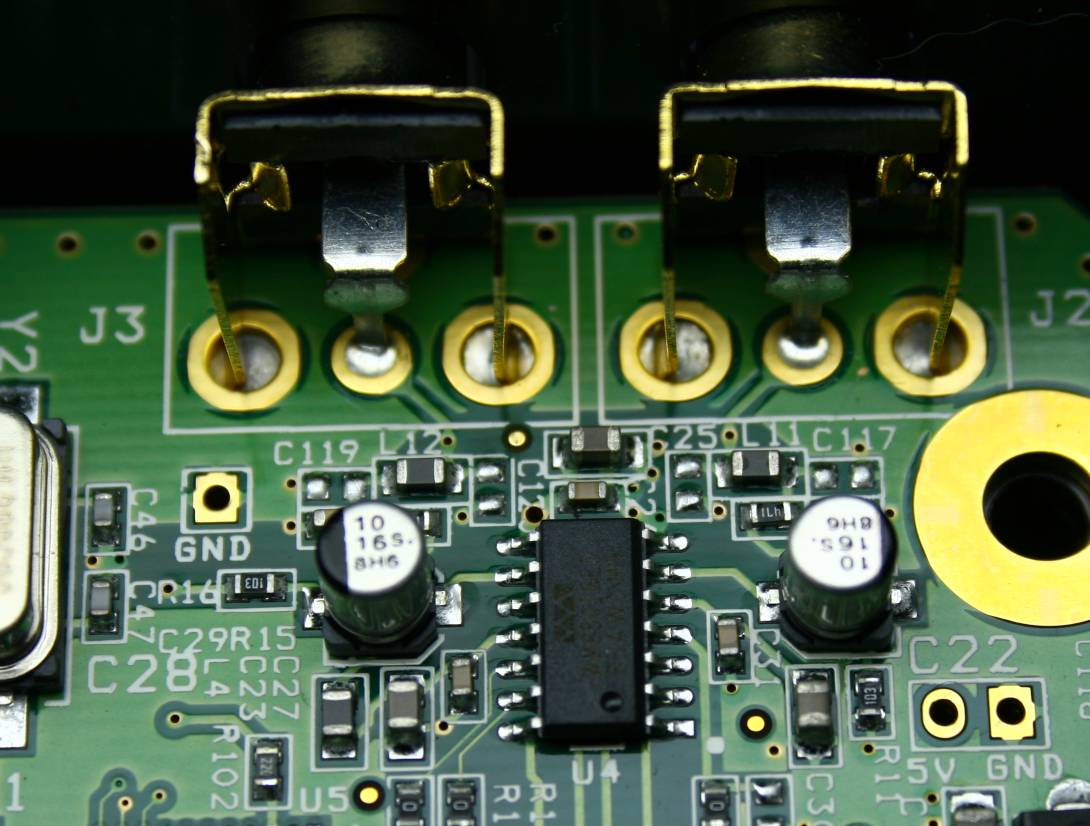
The analog output is beautifully simple. No opamps, no transistors, no
muting, no relays, just decoupling electrolytes (quite bad ones -
visible above silver cans C28 and C22 which must be bypassed by a foil
cap. Do not attempt to replace them because the solder traces will peel
off inevitably. I warned you, didn't I ?) At the
end of the analog path there is a LC filter which I tried to bypass but
the lampizator was very noisy so I decided to keep the entire output
stage of the Wolfson and go to Lampizator from there.
Above - this is the DAC with surrounding electronics. We must try to
improve
it - Input power supply and output caps.
The DAC is designed to work into RCA outputs directly - it has internal
output op-amp stage and analog filter of noise. It should play well
straight into RCA outputs.
Soif you can find a small foil cap like MKT, MKP, MKS, Or paper in oil
or simply an oscon or black gate - anything you can find with
capacitance between 100nF (0,1 uF) and 10 uF - please put it parallel
to the two silver cans - solder directly to their soldering point. -
see photo below.
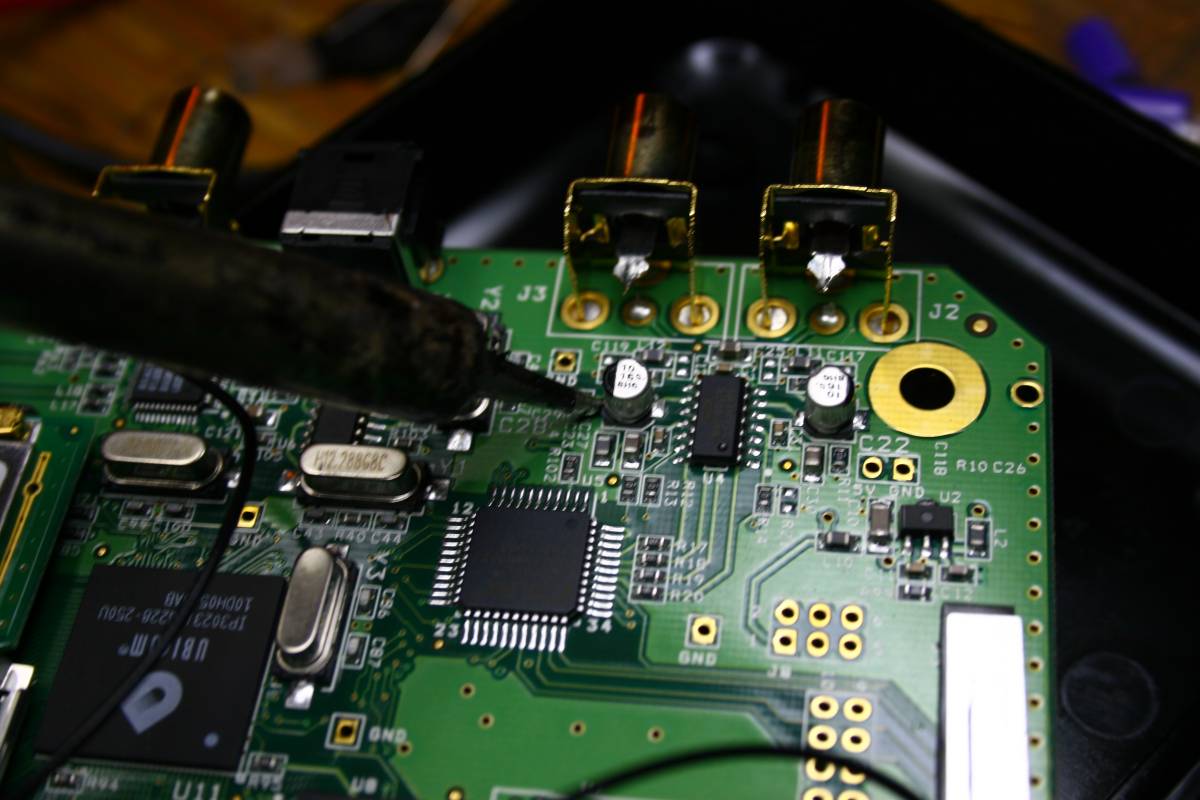
The soldering iron is pointing to the DAC output signal decoupling
caps. They have to be bypassed. Use less than 250 degrees temperature
in
order not to damage fragile PCB traces.
Upgrading power to the Squeezebox
The wall wart provided is just plain HORRIBLE. It belongs in the
dustbin immediately.
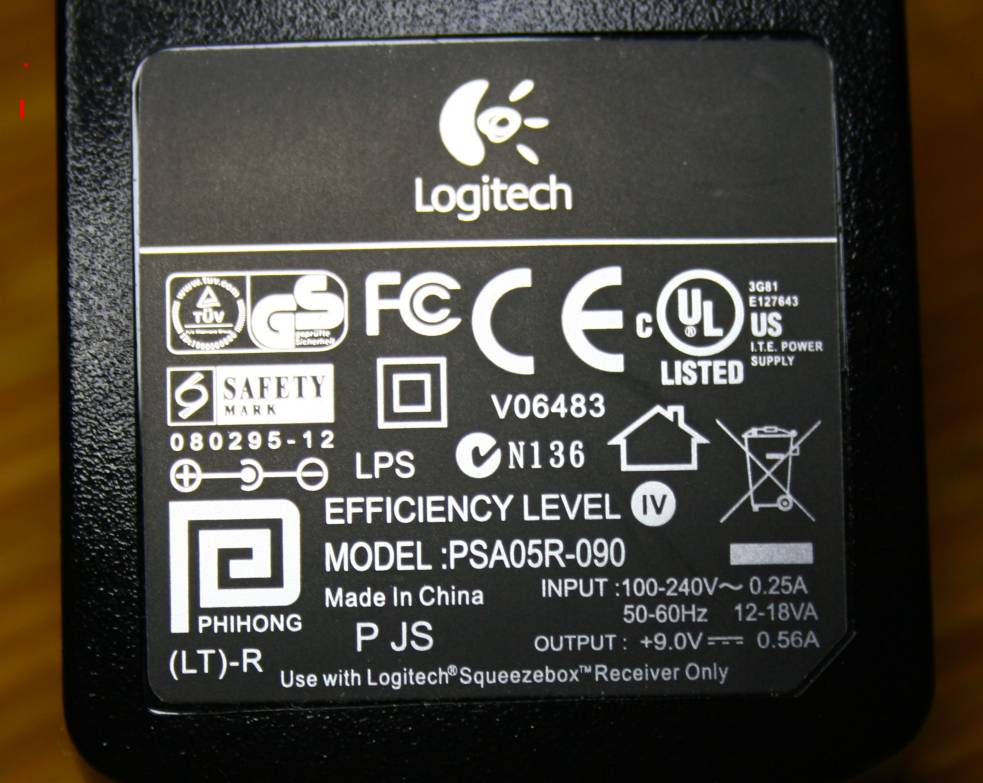
This is the in-adequate power supply wall wart. Observe that when
making your own one - the positive supply PLUS9VDC goes on center pin
of the plug.
I suggest a 10 to 20 Watt (VA) transformer with at least 1A output.
(Naim Flatcap anybody ?)
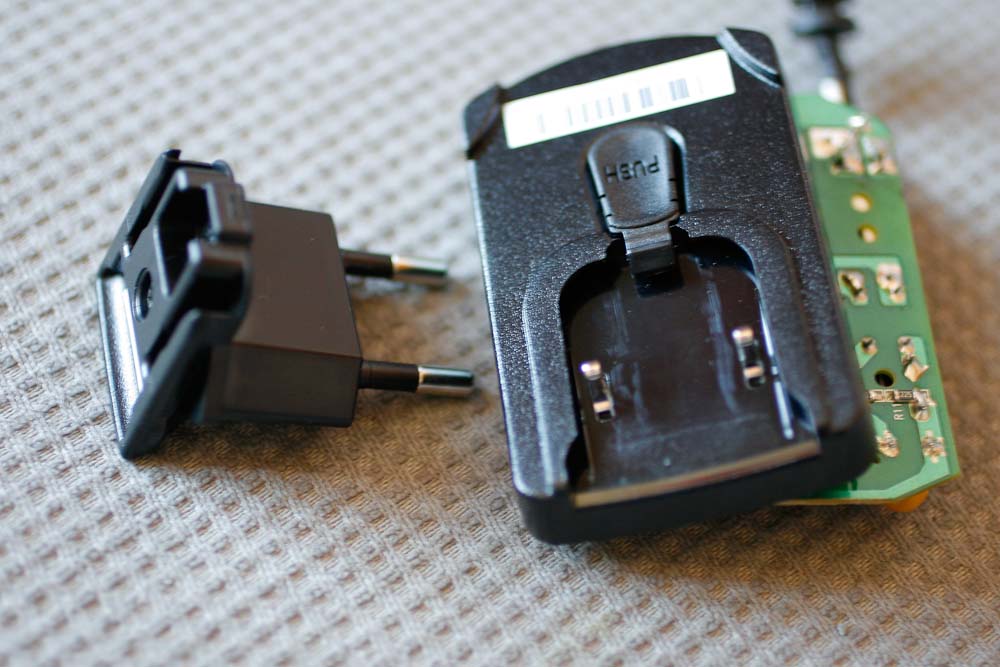
Above: The actual connectors only touch the power supply by the means
of two spring contacts.
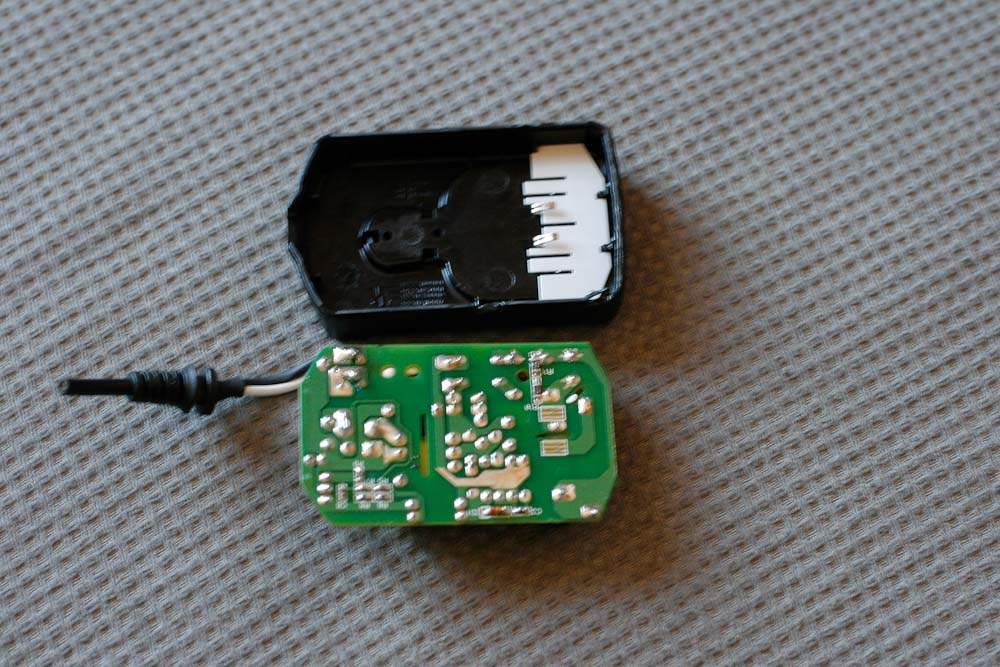
Internally things are no better - the PCB is again touching contacts.
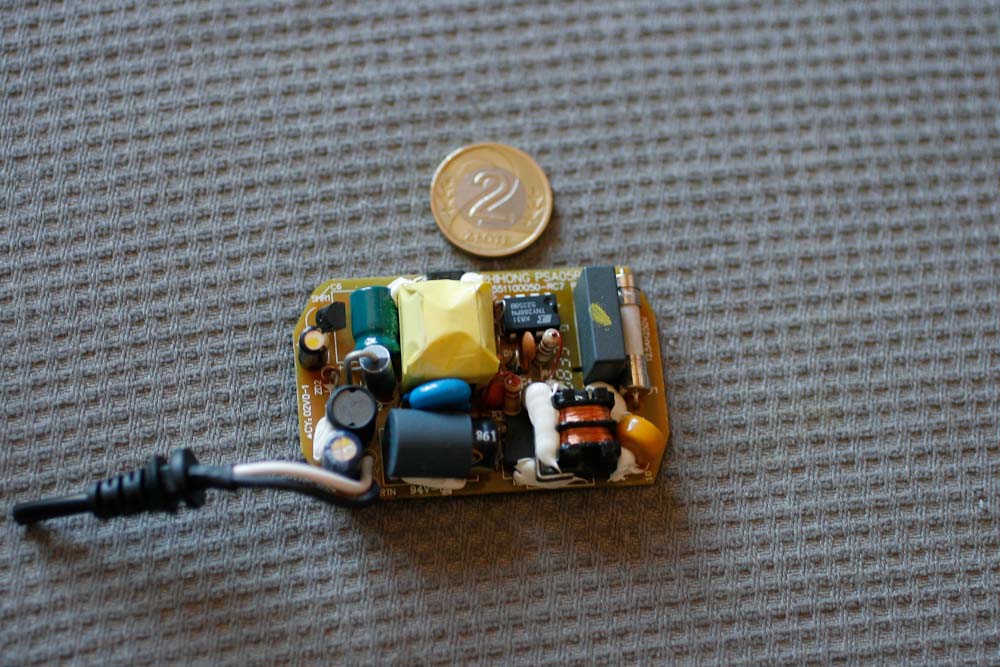
The PCB in its full glory. As we see - thereis no transformer, it is a
purely switching unit, and it is a noise generator.
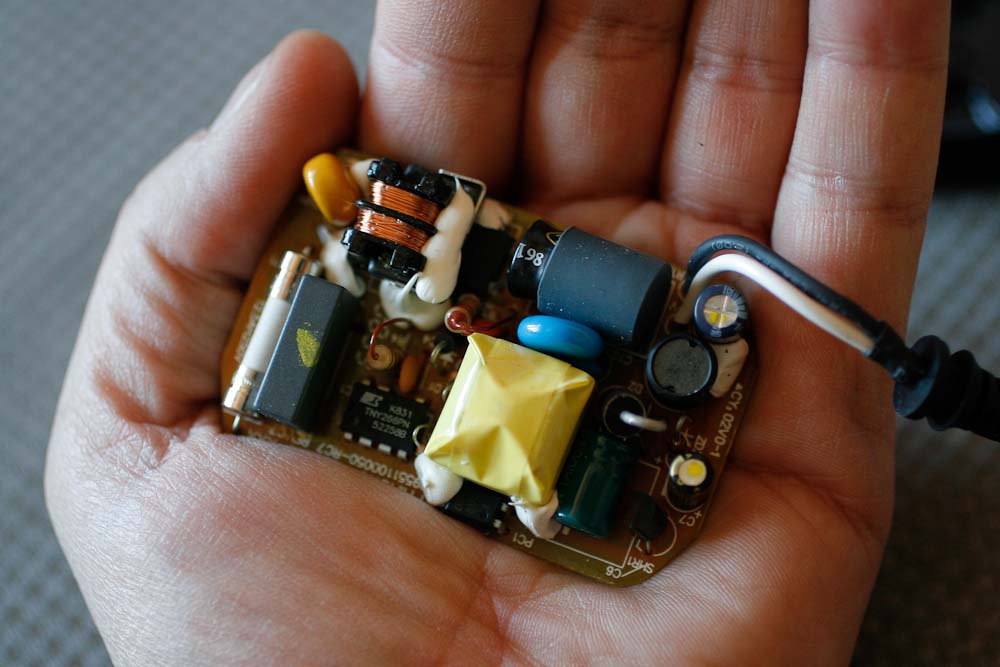
The last look at the power supply before it flew to join the potato
peels.
HERE COMES THE GOOD NEWS:
I tested the Squeezebox as an SP/DIF transport source driving the
all different DACs that I own, among them AD1865 DAC and all prototypes
of the fabulous Lampizator DaC of course. I compared it to the same dac
driven by
a Sony transport and also the same dac but BUILT IN the beautifully
lampized Denon
2560 player. The Squeezebox solution sounds better than any of the
above traditional solutions. How come that it sounds better - I dont
know. It sounds wider, deeper, with more air, more information, more
musical, more enjoyable.
YES FOLKS - to have the convenience of the Squeezebox system we don't
need to compromise on sound. We can still look in the mirror in the
morning.
The Squeezebox transport s/pdif signal SOUNDS BETTER THAN CD
TRANSPORT. And that is the news of the year for me.
The final checklist and pricelist:
1. HDD Raid server D-Link 323 = 200 Eu
2. Two HDD Western Digital Green Line 1,5 TB = 240 Eu
3. Linksys or D-Link wifi router - 50 Eu (plus external longer
antenna)
4. Squeezebox Duet with wireless color screen remote = 300 Eu (SQB
remote (I mention it because it costs 250 Eu) is optional if if
you
have the iPod (new generation of the Touch) or iPhone (any generation).
The iPod / iPhone must be able to connect to the computer and access
the iTunes library files to browse the HDD Server. Then it can become
the ultimate remote controller with finger touch CD cover browsing etc.
5. A computer, preferrably iMac, Powerbook, Atom Laptop or any other
silent computer because it is silent and can be
permanently on in the listening room. Another cool option is HP Touchsmart with
screen that does the finger browsing.
6. The high end DAC with Laampizator or simply - a good DAC full stop.
The rest of the system is as usual.
7. As a cool option I would add the Behringer upsammpler, maybe even
the one with Ultracurve - the digital equalizer function. It would go
between the Squeezebox SPDIF output and the DAC input.
That ladies and gentlemen will be a real 21st century system which will
satisfy the most critical audiophiles and finally will allow our
significant others and the kids too to participate. Everybody can play
whatever s they love - and enjoy great sound - no more daddy shouting
DONT TOUCH THE STYLUS !!!
ALSO PLEASE READ THE ASIOKA PROJECT ARTICLE